
 View Charts
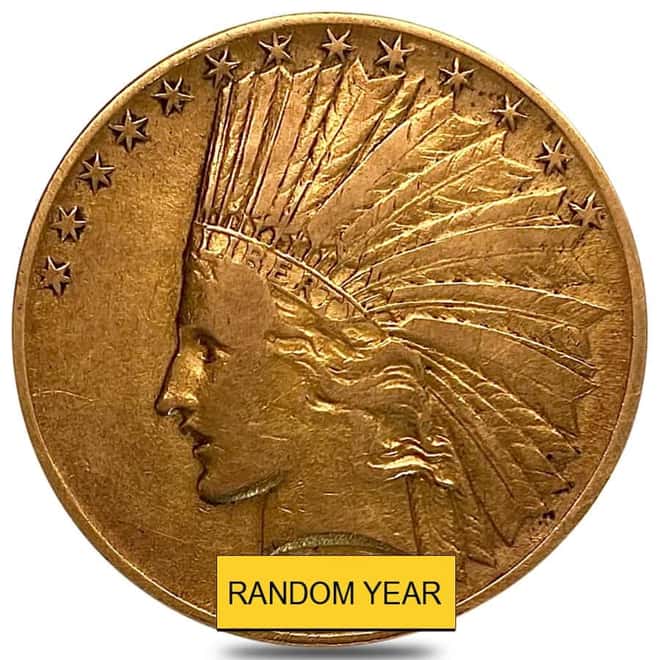
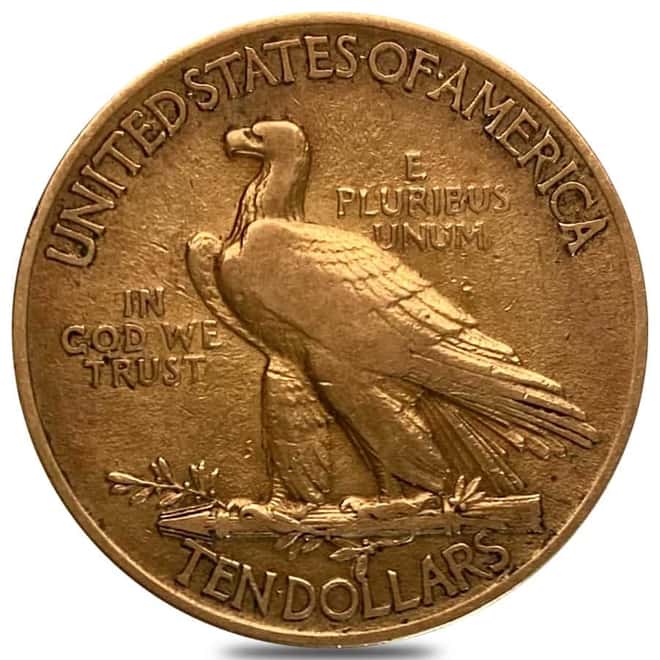
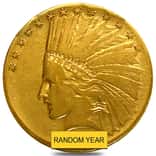
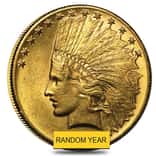
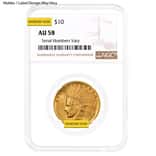
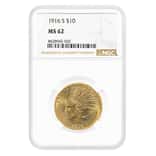
$10 Gold Eagle Indian Head - Very Fine VF (Random Year)
All orders are insured and tracked

The $10 Gold Eagle Indian Head debuted in 1908 and became popular for its avant-garde design which features the portrait of Lady Liberty wearing a Native American feathered War Bonnet. This trailblazing idea was the result of a merger of Augustus Saint-Gaudens creativity and President Theodore Roosevelt’s free-spirited vision. These coins were struck by the US Mint irregularly from 1908 to 1933. These $10 Gold Eagle Indian Heads were the final series of $10 gold coins struck for commerce. The coin is popular for its unconventional yet immensely artistic beauty. Its age, rarity, and historical significance add to its collectible value.
Coin Features:
- Contains .4838 Troy Ounce of 0.900 fine gold.
- Eligible for Precious Metal IRA.
- Very Fine (VF) Condition.
- Obverse: A beautiful leftward facing portrait of Lady Liberty wearing a war bonnet with her curls flowing out of it. The motto “LIBERTY” is inscribed on the band of the bonnet. Encircled by 13 stars on top and date below.
- Reverse: Features a majestic bald eagle perched on a bunch of arrows holding an olive branch in its talons. Inscriptions: "United States of America", "E Pluribus Unum," “IN GOD WE TRUST,” and “TEN DOLLARS.”
- Designed by Augustus Saint-Gaudens.
- Minted from 19071933, dates and mint marks will be chosen randomly based on availability.
- U.S. Mint issue from the following mints: Philadelphia, San Francisco, or Denver.
- Individual coins will come in protective plastic flips. Multiples of 20 will come in protective plastic tubes.
In order to revamp the designs of the coins that had not been changed for almost 60 to 70 years, President Theodore Roosevelt commissioned August Saint Gaudens one of the towering personalities in fine arts at that time to give a new look to all the denominations including $20 Double Eagle, $10 Eagle, $5 Half Eagle, $2.5 Quarter Eagle, and the Cent. Since it had been more than 60 years this could be done without any congressional authorization.
Augustus Saint-Gaudens had prepared various versions of Lady Liberty in bust portrait as well as full-body types for the obverse of the coins and for the reverse he tried versions of eagles in flight as well as standing position. Initially, Gaudens had thought of using the bust portrait of Lady Liberty inspired by a model that he had created of Nike, the Greek Goddess of Victory which he wanted to use for his Sherman’s monument situated in the Central Park, New York City but had not used it. For the reverse, he wanted to use a majestic bald eagle perched on a bunch of arrows and holding an olive branch in its talons which was almost a similar design that he had done for the reverse of the President Theodore Roosevelt’s inaugural medal. This eagle was inspired by the design on the coin of Ptolemy I of Egypt which was illustrated in a book that Gaudens had owned.
However, after a year of correspondence with the President, it was decided that this design will go on the $10 Gold Eagle instead of the $20 Double Eagle. Also, the president had a special suggestion that the laurel wreath that the Lady Liberty is originally wearing be replaced with a feathered headdress that Native Americans wear as he felt that it was very American and picturesque. The headdress on Lady Liberty was felt to be unconventional by many and it was also historically impossible as the feathered headdress or war bonnet was used by male Native American Warriors. This was a rather idiosyncratic idea for that time but this uniqueness is what earned this beautiful coin its place in history. The motto “LIBERTY” has been inscribed on the headband of the bonnet. 13 stars and the date encircle the main device.
On the reverse, the coin features a majestic bald eagle perched on a bunch of arrows holding an olive branch in its talon to symbolize preparedness and peace. The reverse also has inscriptions "United States of America", "E Pluribus Unum," “IN GOD WE TRUST,” and “TEN DOLLARS.”
From 1907 to 1911, the coin featured 46 raised stars on the edge to depict 46 states in the union at that time. From 1912 two more stars were added, in honor of Arizona and New Mexico which were added to United States, so there were 48 stars in total.
Some of the rarest Indian Head Eagles are the 1907 wire rim with periods, 1907 rounded rim with periods, 1908-S, 1911-D, 1913-S, 1915-S, 1916-S, 1920-S, 1930-S, and 1933 issues. These coins are extremely scarce.
Bullion Exchanges is pleased to offer you Gold Eagle Indian Head coins in various denominations at one of the most competitive prices in the industry.
Feel free to browse our vast collection of Pre-1933 US Gold coins today to become a proud owner of an inseparable part of American coinage history. Contact us at 800-852-6884 if you have any questions in regards to Pre-1933 gold coins.