
 View Charts
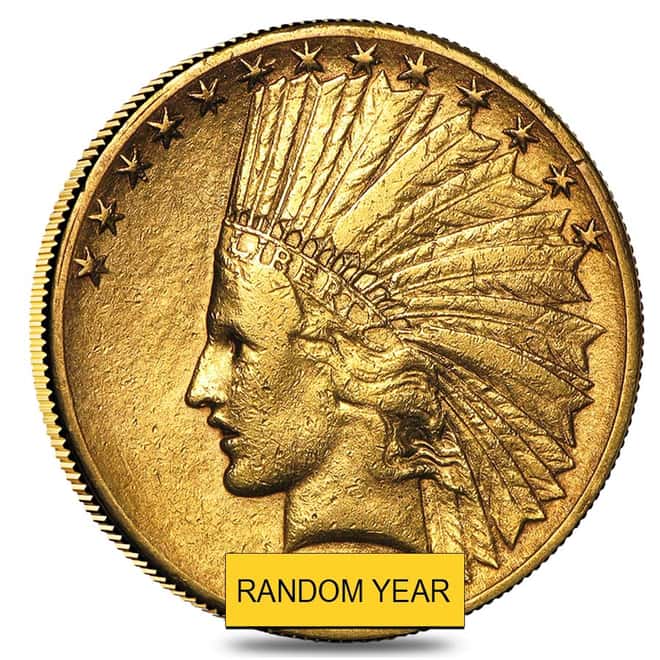
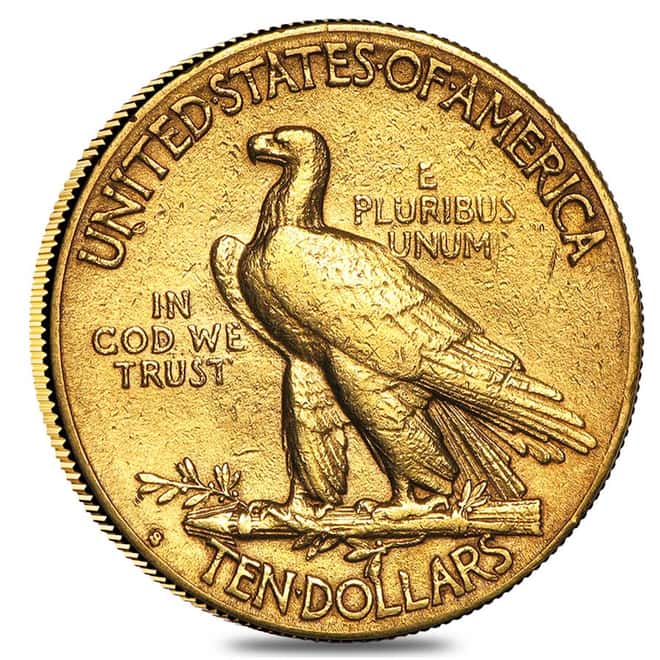
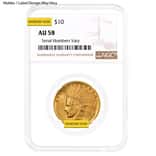
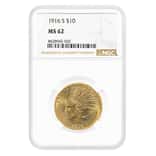
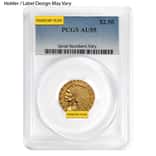
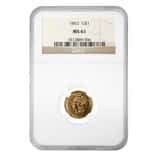
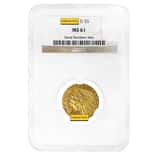
$10 Gold Eagle Indian Head - Polished or Cleaned (Random Year)
All orders are insured and tracked

$10 Gold Eagle Indian Head - Polished or Cleaned (Random Year)
$10 Gold Eagle Indian Head is another great achievement and a beautiful gift to American coinage by Augustus Saint‐Gaudens and President Theodore Roosevelt. It is a ground‐breaking design of Lady Liberty who is actually wearing an Indian War Bonnet, which people of America had not seen or imagined until that time. This is an extremely sought after coin for its maverick design and its rarity. These coins were first minted in 1908 by the US Mint and were minted irregularly till 1933. These were the final series of the $10 gold eagles that were struck for circulation.
Coin Features:
- Contains .4838 Troy Ounce of 0.900 fine gold.
- Eligible for Precious Metal IRA.
- Polished or Cleaned Condition.
- Designed by Augustus Saint‐Gaudens.
- Minted from 1907‐1933, dates and mint mark will be chosen randomly based on availability.
- U.S. Mint issue from the following mints: Philadelphia, San Francisco, or Denver.
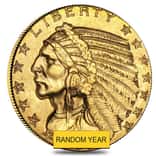
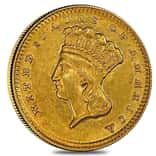
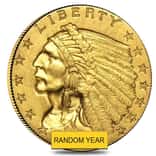
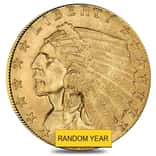
- Obverse: A beautiful leftward facing portrait of Lady Liberty wearing a war bonnet with her curls flowing out of it. The motto “LIBERTY” inscribed on the band of the bonnet. Encircled by 13 stars on top and date below.
- Reverse: Features a majestic bald eagle perched on a bunch of arrows holding an olive branch in its talons. Inscriptions: "United States of America", "E Pluribus Unum," “IN GOD WE TRUST,” and “TEN DOLLARS.”
Why Invest in $10 Gold Eagle Indian Head?
- There is a high demand in market for Pre‐1933 US gold coins due to their design, age, and scarcity.
- Rare coins like the Gold Eagle Indian Head contain the ability to outperform bullion.
- The pre‐1933 gold coins rarely see any hourly fluctuation unlike the regular gold or silver prices.
- U.S. rare coins on many occasions show sustainable demand and increase in price which can lead to a double‐profit.
- The $10 Indian Head Gold Eagle are made from 0.900 fine gold with 10% copper alloy which makes them strong and durable to wear and tear thereby increasing its resale value.
- Helps diversify investment portfolio.
Detailed Information:
It required a flamboyant and magnetic person like President Theodore Roosevelt to change the American Coinage from one that was conventional and boring to the one that was as zestful and beguiling as his own personality. He had commissioned the famous sculptor of the time and his good friend Augustus Saint‐Gaudens to come up with some fresh and modernized designs with great artistic value to grace the American coins. A total of five different denominations were going to get a facelift and they were Double Eagle ($20), Eagle ($10), Half Eagle ($5), Quarter Eagle ($2.5), and the cent.
Gaudens had devised several different versions of Lady Liberty, some in bust versions and some in full body types for the obverse of the coins and for the reverse he had tried experimenting with versions of eagles in flight as well as in standing position.
Initially Gaudens had designed a bust portrait of Lady Liberty for the obverse of $20 Double Eagle which was inspired from a model of the Nike, Greek Goddess of Victory that he had originally wanted to use in his Sherman’s monument at the Central Park in New York City, but had not used it after all. On the reverse he had intended to use a majestic standing eagle similar to the inaugural medal design he had made for Theodore Roosevelt.
However, after much correspondence with the president and upon the president’s suggestion, it was decided that this design be used on $10 Gold Eagle instead of the $20 Double Eagle. The president also suggested to use a headdress for the Liberty instead of the laurel wreath that she was wearing in the initial design. He felt that feather headdress is distinctly American and very picturesque.
The coin also featured raised stars on the edge. From 1907 to 1911, there were 46 stars on the edge to honor the 46 states in the union at that time. Two more stars were added to the 46 stars in 1912 to honor Arizona and New Mexico, which were added to the United States. Some of the rarest Indian Head Eagles are the 1907 wire rim with periods, 1907 rounded rim with periods, 1908‐S, 1911‐D, 1913‐S, 1915‐S, 1916‐S, 1920‐S, 1930‐S, and 1933 issues. These coins are extremely scarce.
In 1933 production of Gold Eagles and other denominations came to an end with the passing of the order by President Roosevelt made it illegal to hold possession of gold coins. All of the coins were confiscated from the public and were melted. The coins that are remaining were the ones that escaped confiscation or those that were sent to Europe before 1933. The distinctive design adds an immense artistic value to the coin and its rarity, age, and historical significance makes it a desirable commodity.
At Bullion Exchanges you can buy Gold Eagle Indian Head coins at one of the most competitive prices in the industry.